
Ballistics and Gunshot Residue Evidence in Arkansas Homicide Cases
Updated: Sep 14
A shell casing, bullet, or trace of residue can become a central part of an Arkansas homicide investigation. But a forensic finding is not the same as proof that a particular person fired a weapon, possessed it, or acted with criminal intent. The meaning depends on how the evidence was collected, preserved, tested, and connected to the rest of the case. For the broader defense framework, read murder defense strategies and trial preparation in Arkansas.
Ballistics and gunshot residue evidence in arkansas homicide cases can help investigators evaluate possible connections among a firearm, ammunition, a person, and a scene. But these findings generally require careful interpretation and do not automatically establish identity or guilt. Gunshot residue is material formed during a firearm discharge, while firearm examination addresses marks and characteristics associated with weapons and ammunition. Both must be considered in context.
This article explains what these examinations can show, where uncertainty enters the process, and how collection methods, laboratory procedures, and expert testimony may affect the State's interpretation. Understanding the basic ballistics analysis process is the first step.
What Is Ballistics Analysis and How Is It Used in Murder Cases?
Ballistics analysis examines firearms, bullets, cartridge cases, and related toolmarks to evaluate whether they may be associated with one another or with evidence recovered during an investigation. In an Arkansas murder case, that association can help investigators reconstruct events. But it does not by itself establish who possessed a firearm, who fired it, or what a person intended.
Firearm and toolmark examiners may document a recovered weapon, examine bullets or cartridge cases, and conduct controlled test-firing when appropriate. They can then compare marks produced by the test ammunition with marks on evidence from a scene. The Arkansas State Crime Laboratory's Firearms/Toolmarks section describes the discipline and its role in forensic examination.
Important distinction: a reported association is an evidence finding. It is not automatically an identification of a shooter or proof that a particular person controlled the weapon at the relevant time.
What the examination may involve
Examining a firearm for function, condition, and features relevant to the testing process.
Comparing microscopic marks on bullets or cartridge cases with marks made by a suspected firearm.
Reviewing the collection, packaging, and documentation of items before testing.
Considering whether the physical evidence fits, conflicts with, or does not resolve competing accounts of what happened.
Investigators may also use the National Integrated Ballistic Information Network, or NIBIN, to identify possible links between ballistic evidence and other shootings. A NIBIN association is best understood as an investigative lead that may guide additional work. It does not, standing alone, prove that a specific individual possessed or fired a weapon.
That limitation matters because trace evidence can be small, transferable, difficult to recognize, and not always persistent. The NIST trace-materials guide describes trace evidence as a way to explore possible associations among people, places, and objects, not as a shortcut to every disputed fact. Accordingly, a careful review considers the complete chain of events, including where an item was found, who had access to it, how it was handled, and what the testing actually shows.
Bottom line: ballistics analysis may address whether a firearm and ammunition evidence could be related. It generally requires other evidence to address possession, identity, timing, and the circumstances of a homicide. Independent review can help distinguish a limited forensic conclusion from a broader prosecution claim.
Question. | May show. | Does not prove. |
Firearm comparison. | Possible association. | Shooter identity. |
GSR testing. | Residue detected. | When or why deposited. |
NIBIN lead. | Possible investigative link. | Shooter identity alone. |
How Reliable Is Gunshot Residue Evidence in Arkansas Courts?
Answer capsule: Gunshot residue (GSR) is material formed when a firearm is discharged. A detected particle pattern may be relevant, but it does not answer every question by itself. Reliability depends on when and how samples were collected, whether transfer or contamination was possible. How long residue persisted, and whether the testing method and interpretation fit the case.
GSR is a form of trace evidence. The National Institute of Standards and Technology defines it as residues formed during the discharge of a firearm. NIST also explains that trace evidence is used to explore possible associations among people, places, and objects, not automatically to establish identity or intent. That distinction matters in an Arkansas homicide case. A laboratory finding must be evaluated alongside the collection record, other physical evidence, witness accounts, and the specific proposition the State wants the jury to accept.
Collection timing is one important consideration. Trace material can be small, variable, and easily transferred, and it may not persist. Contact with another person or object, ordinary movement, washing, medical treatment, or the passage of time can affect what remains available for testing. Investigators also need to document who collected each sample, what surfaces were tested, how the samples were packaged, and how they moved through the evidence system. NIST identifies evidence collection and packaging as part of crime-scene investigation guidance.
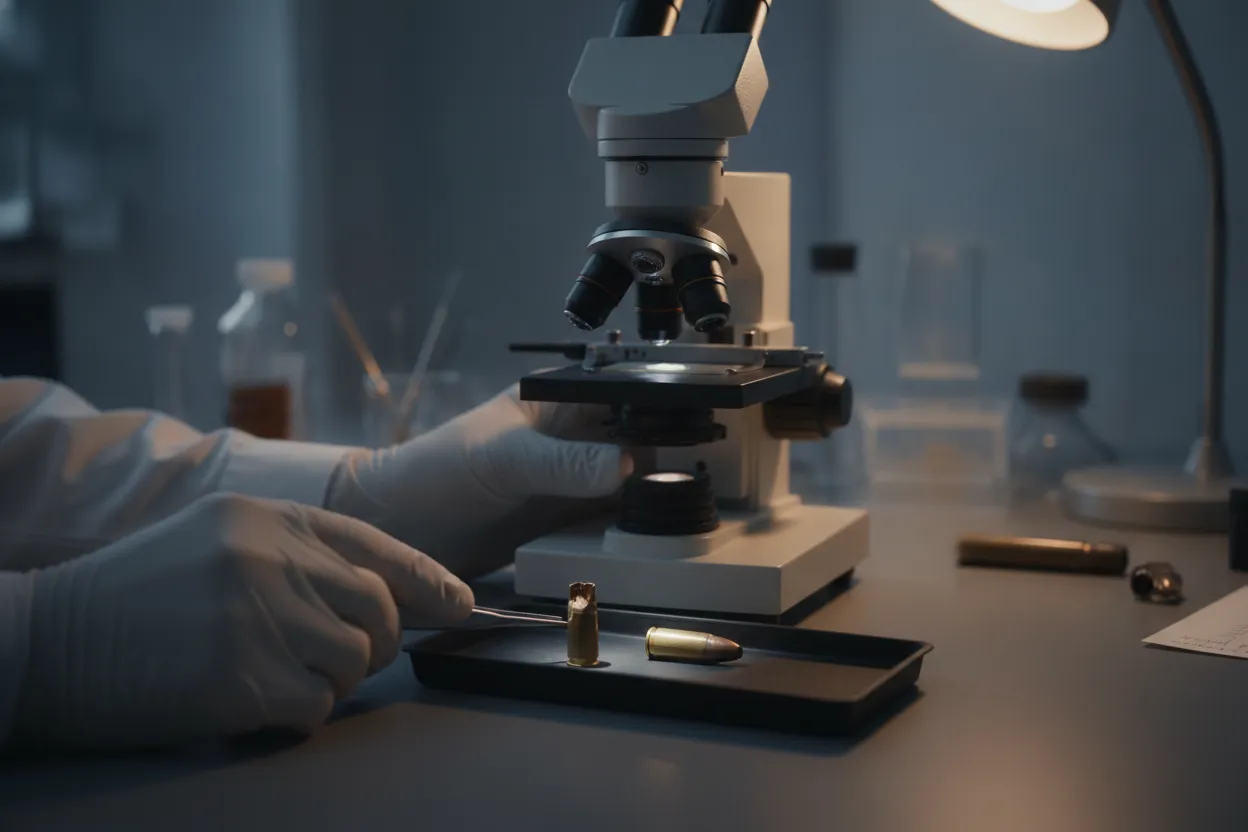
Forensic testing can provide information for a larger reconstruction, but the collection history and limits of the method remain important.
The analytical method also deserves careful review. NIST lists ANSI/ASTM E1588-25 as a published standard for gunshot residue analysis using scanning electron microscopy and energy dispersive X-ray spectrometry. A standard can provide a framework for testing, but it does not eliminate case-specific questions. Counsel and an appropriate forensic expert may need to examine the laboratory report, particle classification, controls, and analyst qualifications. They may also examine deviations from protocol and the difference between a finding consistent with discharge and proof that a particular person fired a particular weapon.
GSR evidence can be meaningful without being conclusive. Its value may change depending on transfer, persistence, handling, contamination controls, and the competing explanations supported by the record. A defense review can test whether the reported finding supports only a limited association. It can also ask whether the State is asking the jury to infer possession, timing, identity, or intent beyond what the science establishes. The National Institute of Justice review of GSR composition, collection, persistence, and analysis provides additional context for those limits.
What Are Common Defense Challenges to Ballistics and GSR Evidence?
Defense review asks whether ballistics or gunshot residue findings were collected correctly, preserved, tested with a validated method, and interpreted within their limits. In an Arkansas homicide case, a forensic association may raise questions. But it does not automatically establish who fired a weapon, when contact occurred, or what a person intended. These questions fit within the broader Arkansas murder defense strategies and trial preparation framework.
Takeaway: The strength of this evidence depends on the complete process, from the scene and laboratory records to the examiner's conclusion and the alternative explanations supported by the rest of the case.
Collection and preservation.
Investigators must identify, document, collect, package, and preserve relevant items in a way that allows later review. Trace evidence can be difficult to recognize, may not persist, and can transfer between locations. The National Institute of Standards and Technology identifies evidence collection and packaging as part of crime-scene investigation guidance, including for shooting scenes. Defense counsel may therefore examine what was collected, what was missed, when samples were taken, and whether packaging protected the evidence. See the
challenging forensic evidence in Arkansas murder cases
for related issues.
- Chain of custody.
Records should account for who handled each firearm, cartridge, clothing item, swab, or other exhibit, when it changed hands, and how it was stored. Gaps, inconsistent descriptions, unexplained access, or discrepancies between scene notes and laboratory records can affect authentication and the weight a fact-finder gives the item. The issue is not merely whether a report exists, but whether the history of the exhibit is complete and reliable.
- Contamination and transfer.
Gunshot residue is trace material formed during the discharge of a firearm. Trace material can be small, variable, and easily transferred. A defense review considers possible secondary transfer, contact with surfaces or people, handling by investigators, movement after the alleged event, and the timing of collection. A detected particle or pattern should not be treated as a complete narrative without examining those possibilities.
- Testing method and validation.
Counsel may ask what analytical method was used and whether the laboratory followed its written protocol. Counsel may also ask whether controls and quality records were maintained and whether the method supports the exact conclusion offered. NIST lists ASTM E1588-25 as a published standard for gunshot residue analysis using scanning electron microscopy and energy dispersive X-ray spectrometry. That standard does not eliminate the need to examine how a particular laboratory applied its method.
- Examiner qualifications and interpretation.
The examiner's training, experience, proficiency testing, laboratory accreditation, peer review, and limits on the opinion can matter. A report may accurately describe an observation while an advocate presents it more broadly than the testing supports. Independent expert review can help separate the underlying result from an overstated inference.
- Relevance, authentication, and weight.
Arkansas courts evaluate evidence through the applicable rules and case-specific foundation. The defense may question whether the item is connected to the alleged event and whether the State has established what it claims the item is. Counsel may also examine whether the proposed testimony would assist rather than confuse the fact-finder. Even admitted evidence remains subject to arguments about reliability, relevance, and weight.
- Alternative explanations.
Finally, the defense compares the forensic finding with witness accounts, scene reconstruction, medical evidence, digital evidence, possession evidence, and the timeline. Trace evidence is analyzed to explore possible associations between people, places, and objects. Association is not the same as identity or proof beyond a reasonable doubt, so the complete record matters.
What Can a Defense Expert Do to Counter Prosecution Ballistics Claims?
A defense firearms or trace-evidence expert can test the exact proposition the State wants the jury to accept. A laboratory conclusion is not the end of the analysis. The review may examine the physical evidence, laboratory file, collection history, protocols, reports, and testing limits. It may also examine the difference between an association and proof of identity, possession, timing, or intent. The expert may then help counsel develop motions and cross-examination, without promising that evidence will be excluded or that a particular result will follow.
A useful expert review connects a technical finding to the precise legal question. Identifies what the evidence does not establish, and gives counsel a grounded way to test the prosecution's interpretation.
Define the proposition before evaluating the test
The gun was involved" can mean several different things. It might refer to a claimed firearm-to-cartridge association, the presence of residue on clothing or skin. A reconstruction theory, or an inference about who fired a weapon and when. Those propositions require different evidence and different limits. An expert can help separate the laboratory observation from the broader conclusion the prosecution draws from it.
That distinction matters because trace evidence is generally analyzed to explore possible associations among people, places, and objects. It may help investigators corroborate statements or consider a sequence of events, but an association is not automatically an identification of a person as the shooter. The defense review should ask what the reported finding actually supports and what additional assumptions are required to reach the State's conclusion.
Inspect the evidence and the laboratory record
An expert may examine the firearm, ammunition, clothing, swabs, collection photographs, and packaging. The review may also include chain-of-custody records, laboratory notes, instrument data, quality-control materials, and the final report, to the extent those materials are available. For gunshot residue, the review can consider collection timing, handling, possible transfer, persistence, the method used, and whether the report describes both detected material and limitations. NIST identifies evidence collection and packaging as part of crime-scene investigation guidance. While its published information also identifies a standard for gunshot residue analysis using scanning electron microscopy and energy dispersive X-ray spectrometry. Those references provide points for evaluation, not a conclusion about a particular Arkansas case.
For firearm or toolmark claims, the expert can compare the questioned items with the underlying images, notes, test procedures, and wording used in the report. Missing photographs, incomplete documentation, untested items, unclear controls, or a conclusion that reaches beyond the observations may create issues for counsel to investigate. The absence of a record does not automatically prove misconduct or contamination, but it can affect how confidently a finding should be presented.
Support motions and cross-examination
The defense lawyer may use the expert's analysis to evaluate requests for additional discovery, testing, preservation, or a hearing concerning the admissibility or weight of evidence. At trial, the expert can explain technical terms, expose unsupported leaps, identify alternative explanations, and clarify the difference between "consistent with" and "proves." Whether a court admits evidence, limits testimony, or allows a particular challenge depends on the record and applicable law.
For a broader explanation of how specialists may assist with prosecution evidence, see expert witnesses in Arkansas murder trials. Every case is unique, and an independent review may identify concerns without guaranteeing exclusion, dismissal, or any other outcome.
Ballistics and Gunshot Residue Evidence in Arkansas Homicide Cases
Answer in brief: Ballistics and gunshot residue evidence in Arkansas homicide cases may show possible links among firearms, ammunition, people, objects, and events. Those findings generally answer limited forensic questions. They do not, by themselves, establish who possessed a weapon, when it was fired, why it was fired, or whether the accused is guilty.
The central issue is the difference between association and identity. Trace evidence is analyzed to explore possible associations between people, places, and objects, according to the NIST trace-materials guide. An association can be relevant without being an identification. For example, a firearm examination may compare a bullet or cartridge case with a submitted weapon and report whether observed markings are consistent with that weapon. That finding does not necessarily prove who held the firearm or fired it at the relevant time.
The same caution applies to gunshot residue. NIST defines gunshot residue as residue formed during the discharge of a firearm. A detected particle or particle population may be consistent with exposure to a firearm discharge. But detection is not the same as proving that a person fired the gun. Residue may be affected by transfer, contact with another surface, collection practices, environmental conditions, and the time between an event and sampling. Conversely, a lack of detected residue does not automatically resolve what happened.
Detection is not activity. A laboratory result describes what was found on a submitted item and how the analyst interpreted it under the applicable method. It may not identify the activity that placed the material there. The NIST guide notes that trace materials can be small, variable, transferable, difficult to recognize, and not always persistent. Those characteristics make the collection record, packaging, handling history, and timing important parts of interpretation, not administrative details to overlook.
For that reason, forensic findings must be compared with the full timeline. Investigators and counsel may need to examine when a person encountered the firearm, who had access to it, when clothing or other items were collected, whether witnesses describe a different sequence, and whether digital, medical, physical, or scene evidence supports the proposed account. A result that appears powerful in isolation may carry a different meaning when those surrounding facts are tested. Context can change the weight of the conclusion.
In an Arkansas homicide case, independent review can help separate the laboratory conclusion from the broader prosecution theory. The defense may scrutinize the underlying data, stated limitations, collection and transfer history, and whether the opinion goes beyond what the testing can support. The goal is not to dismiss technical evidence automatically. It is to ask the narrower, more accurate question: what does this finding actually show, and what does it leave unresolved?
What Should Families Ask About Ballistics or GSR Evidence?
Families and defendants should ask what the forensic evidence actually proves, how it was collected, and whether the State's interpretation goes beyond the testing. A complete review should address reports, notes, photographs, raw data, chain of custody, firearm testing, GSR collection, expert qualifications, preservation, and applicable deadlines.
These questions do not determine the outcome of a case by themselves. They help organize the records counsel and qualified experts may need to evaluate the evidence in its full Arkansas homicide-case context.
- What exact proposition does the State claim?
Is the evidence offered to suggest that a firearm fired a particular projectile, that a person handled or discharged a firearm, or that the person was present at a particular time? Those are different propositions and require different support.
- Do we have the complete file?
Ask for laboratory reports, bench notes, photographs, instrument or microscopy data, diagrams, examiner communications, supplemental reports, and any disclosure describing limitations or inconclusive findings.
Can the chain of custody be reconstructed?
The review should identify who collected, packaged, transported, stored, opened, tested, and returned each item. NIST identifies evidence collection and packaging as part of crime-scene investigation guidance, while trace materials can be small, transferable, and difficult to recognize or preserve.
provides useful context.
- What firearm and ammunition testing occurred?
Ask whether the alleged firearm was recovered, whether it was function-tested, and what comparison material was examined. Also ask whether the report states an identification, exclusion, inconclusive result, or another conclusion.
When and from whom was GSR collected?
Ask about the collection time, the surfaces sampled, contact with other people or objects, washing or handling, packaging, and the laboratory method. GSR is residue formed during firearm discharge, but its presence or absence must be interpreted with the circumstances and timing in mind.
in those terms.
- Has an independent expert reviewed the work?
Ask whether a qualified expert can assess the methods, documentation, examiner qualifications, interpretation, and limits without assuming the prosecution's theory is correct.
Preservation matters because trace evidence may not persist, and records or physical samples may become harder to evaluate as time passes. Families should ask counsel what must be preserved, what additional materials should be requested, and which case-specific deadlines apply. The firm describes expert-witness deployment and independent investigation as important to understanding and challenging prosecution evidence, but the appropriate review depends on the actual file.
Takeaway: The most useful first question is not whether ballistics or GSR sounds persuasive. It is what precise conclusion the evidence supports, what information is missing, and whether an independent review can test that conclusion.
Frequently Asked Questions
Does gunshot residue prove that someone fired a gun?
No. Gunshot residue is formed during firearm discharge, but detecting residue does not by itself establish who fired a weapon, when it was fired, or what a person intended. Collection timing, transfer, persistence, and the surrounding evidence all matter. NIST defines gunshot residue as residues formed during the discharge of a firearm.
Can gunshot residue disappear before police collect a sample?
Yes. Trace evidence can be small, transferable, difficult to recognize, and unable to persist indefinitely. That means investigators should examine when and how samples were collected, packaged, documented, and analyzed. A negative result also requires context because it may not answer every question about contact with a firearm.
What does a ballistics examination actually compare?
A firearm and toolmark examination may compare marks associated with a firearm, ammunition, or projectile. The significance of a reported association depends on the items tested, the condition of the evidence, the method used, and the examiner's reasoning. An association is not automatically proof of identity, possession, or the complete sequence of events.
How can a defense lawyer challenge ballistics or GSR evidence?
Counsel may examine collection procedures, chain of custody, possible contamination or transfer, laboratory records, testing methods, examiner qualifications, and the limits of the conclusion. An independent forensic expert may help evaluate the underlying data and explain whether the State's interpretation goes beyond what the evidence supports.
What should a family do if forensic evidence is central to the case?
Preserve all paperwork and communications, avoid discussing the facts publicly, and provide counsel with discovery, search-warrant materials, laboratory reports, and charging documents. Prompt review can help identify evidence that needs preservation or independent examination. Every case is unique, so this general information is not a substitute for advice about a specific Arkansas case.
Ready to Discuss the Evidence in Your Case?
Ballistics and gunshot residue findings should be examined in the context of the collection process, testing methods, and the State's specific claims. A careful review may help identify questions for investigation, expert analysis, or courtroom preparation. To request a confidential Arkansas homicide defense consultation, contact Arkansas Murder Lawyers through the contact page or call 501-424-7114. This information is general and not case-specific legal advice.



Comments