
Expert Witnesses in Arkansas Murder Trials
Updated: Sep 14
Expert witnesses in Arkansas murder trials can help a jury understand technical evidence, from DNA and firearm analysis to autopsy findings and digital records. They do not decide guilt. Their job is to explain specialized information, test the State's interpretation, and identify what the evidence can and cannot establish in the particular case.
What Types of Expert Witnesses Appear in Arkansas Murder Trials?
In Arkansas murder trials, expert witnesses are professionals whose specialized knowledge may help the jury evaluate a disputed fact. The right expert depends on the charge, the evidence, and the State's theory. A defense lawyer may retain one expert to test the prosecution's proof or several specialists whose opinions address different parts of the same timeline.
The most useful expert is not necessarily the person with the longest resume. It is the qualified specialist whose method answers a real issue in the case.
- Forensic pathologist:
Reviews autopsy findings, injuries, cause of death, manner of death, and the limits of any time-of-death estimate.
- DNA or forensic biology analyst:
Examines collection, laboratory protocols, mixtures, transfer, contamination, statistical interpretation, and whether a result connects a person to the alleged offense.
- Firearms and toolmark examiner:
Evaluates firearm comparisons, cartridge cases, bullets, trajectory evidence, and the assumptions behind a conclusion.
- Crime-scene reconstruction specialist:
Tests whether the State's proposed sequence is physically consistent with measurements, photographs, blood patterns, video, and witness accounts.
- Digital forensics examiner:
Reviews phones, messages, location data, video, computer records, metadata, extraction methods, and missing or altered information.
- Mental-health professional:
May address fitness to proceed, mental disease or defect, criminal responsibility, or another issue when the defense and the court's orders make that testimony relevant.
- Human-factors or memory expert:
May explain perception, stress, lighting, distance, memory formation, or identification procedures when eyewitness reliability is disputed.
For a broader look at how these specialists fit into a defense plan, read Arkansas murder defense strategies and trial preparation. That pillar article covers the larger case strategy; this page focuses on the expert-witness decision and courtroom role.
How the Defense Uses Forensic Experts to Challenge the Prosecution
Forensic experts help the defense separate a test result from the conclusion the prosecution wants the jury to draw. They inspect the evidence, records, protocols, and underlying assumptions, then explain whether the method was reliable and whether the result actually fits the facts. This is different from rejecting science simply because it hurts the defense.
A forensic result may be accurate and still fail to prove identity, intent, timing, or the complete sequence of events.
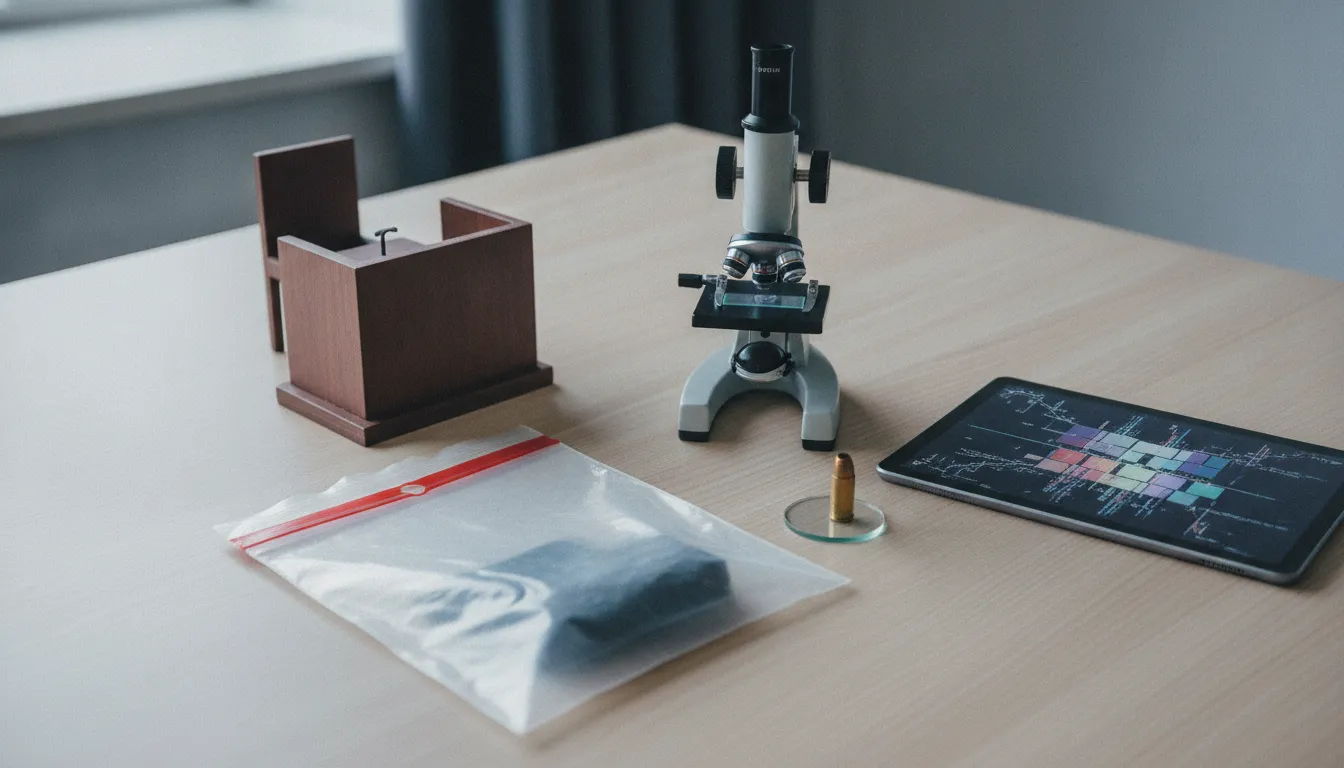
A defense expert compares the physical evidence, testing method, and case timeline before forming an opinion.
Evidence area | Questions an expert may examine | What the opinion cannot do by itself |
DNA | Was the sample collected, preserved, tested, and interpreted correctly? Could transfer or contamination explain the result? | Automatically establish when DNA arrived, how it got there, or who committed the homicide. |
Firearms | Do the physical marks support the claimed comparison? Does the trajectory fit the scene and the proposed position of each person? | Prove the shooter's identity or resolve every disputed fact in the case. |
Autopsy and injuries | Are the cause and manner of death conclusions supported by the records, photographs, toxicology, and injury pattern? | Determine the defendant's legal guilt or replace the jury's fact-finding role. |
Digital evidence | How was data extracted? Are timestamps, location signals, messages, and account records complete and authenticated? | Guarantee that a device record describes the user's actions without context or alternative access. |
Scene reconstruction | Can the proposed sequence be reconciled with measurements, blood patterns, video, physical traces, and witness testimony? | Provide a complete narrative when important inputs are missing or unreliable. |
In Prater v. State, the Arkansas Supreme Court addressed scientific reliability, jury confusion, and whether a method fit the disputed facts. It also emphasized an accused person's opportunity for independent review of DNA data and methods. Read the Arkansas Supreme Court's Prater v. State opinion.
Takeaway: The strongest forensic testimony is specific. It identifies a method, assumption, gap, or alternative explanation, then explains why that point changes the weight or meaning of the evidence.
Ask Arkansas Murder Lawyers how independent expert review may apply to your case. Call 501-424-7114.
Mental Health Expert Witnesses: When and How They Are Used
Mental-health experts may become important when a defendant's ability to proceed, mental disease or defect, criminal responsibility, or another mental-health issue is legally relevant. Arkansas law distinguishes a fitness-to-proceed examination from a criminal-responsibility examination. The exact notice, examination, report, and testimony requirements depend on the defense raised and the court's orders.
Mental-health testimony must connect clinical findings to a legally relevant question without allowing an expert to decide the ultimate issue for the jury.
Fitness to proceed and criminal responsibility are different questions
Fitness to proceed generally concerns the defendant's present ability to understand the proceedings and assist counsel. Criminal responsibility focuses on the defendant's mental condition at the time of the alleged conduct. A single evaluation should not be assumed to answer both questions. Counsel must identify which issue is presented, follow the applicable Arkansas procedure, and understand what information the examiner considered.
Arkansas Code section 5-2-305 addresses mental-health examinations in this setting and provides for qualified psychiatrists or psychologists to examine and report on a defendant's mental condition. The current statute, the applicable rules, and the circuit court's order control. A family member should not assume that arranging a private evaluation alone creates an admissible defense.
What can a mental-health expert explain?
The diagnosis or symptoms supported by the records and examination.
The difference between a clinical conclusion and a legal standard.
How the reported condition may relate to appreciation of conduct or ability to conform conduct to the law, when the issue is properly presented.
Whether the expert's opinion is limited by incomplete records, unreliable history, malingering concerns, or the timing of the evaluation.
An expert cannot guarantee a not-guilty-by-reason-of-mental-disease-or-defect verdict. The jury evaluates the evidence under the court's instructions, and the State may present its own expert. For more background on the legal issues rather than the witness-selection process, see mental state defenses in Arkansas murder cases.
How Do Arkansas Courts Qualify an Expert Witness?
Arkansas Rule of Evidence 702 generally permits qualified expert testimony when specialized knowledge will help the trier of fact understand evidence or decide a fact in issue. Qualification may come from knowledge, skill, experience, training, or education. The judge may also examine the reliability, relevance, foundation, and limits of the proposed opinion before the jury hears it.
Being called an expert is not enough. The proponent must show that the witness, method, data, and opinion fit the disputed issue in the case.
The Arkansas Rules of Evidence, including Rules 702 through 706, address expert testimony, its basis, underlying data, and court-appointed experts. Counsel should ask several questions:
- Is the witness qualified?
Education matters, but so do experience, training, licensing, and work with the specific method.
- Is the method reliable?
The court may examine how the technique works, testing, quality controls, and methodology.
- Is the opinion relevant?
The testimony must help the jury decide a material fact and address the State's theory.
- Is the foundation complete?
The expert needs reliable data, accurate records, and enough information to explain the conclusion.
- Are the limits clear?
The expert should identify uncertainty, assumptions, missing information, and alternative explanations.
The other side may challenge the foundation, cross-examine the witness, present a competing expert, or argue that the opinion deserves little weight. The court may limit the subject or form of testimony. A ruling about admissibility does not mean the jury must accept the opinion.
Disclosure also matters. Arkansas criminal discovery rules and the circuit court's scheduling orders govern witness identification and required reports. Defense counsel should request the State's expert materials, calendar deadlines, and address late-discovered issues early.
Why Does Access to Expert Networks Matter When Choosing a Murder Defense Attorney?
Expert access matters because an Arkansas murder defense often requires more than reading a police report. Counsel must identify the claim that needs testing, locate a specialist with the right experience, provide complete materials, protect confidential work product when applicable, and translate the resulting opinion into a focused litigation decision.
The value of an expert network is not the number of names on a list. It is the defense team's ability to match the right specialist to the right disputed fact early enough to use the work.
A practical defense review may proceed in stages:
- Map the State's theory:
Identify what the prosecution must prove, which evidence supports each part, and where a technical inference is doing important work.
- Preserve the evidence:
Secure reports, photographs, video, laboratory records, extraction files, and physical exhibits before they disappear or become harder to test.
- Select the specialty:
Use a pathologist for medical questions, a DNA analyst for biological evidence, a firearms examiner for firearm evidence, a digital examiner for device records, or another specialist whose experience matches the actual issue.
- Test the opinion:
Ask the expert to review both favorable and unfavorable information. A credible opinion must account for the complete record, not just facts selected by one side.
- Choose the litigation use:
The work may support a motion, expose a weakness in cross-examination, provide a defense opinion, guide negotiations, or show that additional investigation is needed.
Early preparation helps counsel coordinate expert work with witness interviews, suppression motions, jury strategy, and the overall trial plan. The firm's Arkansas murder trial jury-selection resource explains why technical evidence must ultimately be presented in a way jurors can evaluate.
Arkansas Murder Lawyers focuses exclusively on murder and homicide defense statewide. Lead attorney Kevin Lemley personally handles the defense, connecting the legal theory, investigation, expert review, and trial preparation from the beginning.
Frequently Asked Questions About Expert Witnesses in Arkansas Murder Trials
Expert witnesses in an Arkansas murder trial may explain specialized evidence, challenge a prosecution method, or provide an opinion on a legally relevant mental-health issue. Their testimony must satisfy Arkansas evidence rules and remain within the witness's qualifications and reliable foundation. The judge controls admissibility, while the jury decides what weight the testimony deserves.
Can an expert witness prove that someone is innocent?
No. An expert may identify weaknesses in testing, offer an alternative interpretation, or explain why evidence does not establish a particular fact. The expert generally does not decide whether the defendant is guilty or innocent. The jury evaluates the expert's opinion along with all other evidence, and the State retains the burden of proving the charged offense beyond a reasonable doubt.
Who pays for a defense expert in an Arkansas murder case?
Funding depends on the defendant's circumstances, the expert's role, and court procedures. A retained expert may be paid by the defense. An eligible defendant who cannot afford necessary assistance may ask the court for authorization or funds under the applicable Arkansas procedure. Counsel should raise the issue early because an expert needs time to review records and prepare a reliable opinion.
Can the prosecution use its own expert witness?
Yes. The State may present qualified expert testimony to support its interpretation of forensic, medical, digital, or other technical evidence. The defense can review the expert's qualifications, methods, data, assumptions, and conclusions, then use cross-examination, a motion, independent testing, or a defense expert to address the testimony. The court decides admissibility, and the jury decides weight.
Can a mental-health expert testify about intent in Arkansas?
Sometimes, but the scope is case-specific. A mental-health expert may address a properly raised mental disease or defect issue and explain clinical findings that bear on a legal question. The court may limit testimony that would improperly tell the jury whether a required element, such as purposeful intent, has been proved. The defense must follow Arkansas notice and examination procedures.
When should a defense lawyer look for an expert?
As early as possible after counsel identifies a technical issue. Early review allows the defense to preserve evidence, request underlying data, seek testing, assess whether a motion is appropriate, meet disclosure requirements, and decide whether the expert should consult or testify. Waiting until trial can limit the specialist's review and make it harder to respond to the State's evidence fairly.
Every Arkansas murder case is different. A qualified attorney can evaluate the evidence, identify the disputed issues, and determine whether expert review would help.

Comments